Posts

Agile and the revival of Sonic

Image
My daughter loves this movie, we watched it a few times together. She became fond of Sonic characters and even has Sonic and Tails Toys. But what does an imaginary blue hedgehog has to do with Agility? Well, it is not his speed. Sega released the first Sonic game 30 years ago. A lot of games were released at that time and A movie was announced. Sonic is a blue hedgehog that is fast (in case you really don’t know) and to create a movie with sonic you need to get the character from the animated world to the real world. The objective was to have Sonic as a realistic character, this is an understandable creative constraint. He is after all in the real world and if you think about other movies that had this realism such as lion king you would understand that need. However, It was a creative constraint that took away from what people wanted, and they wanted an interesting character. It worked for the Lion king because those are real animals. To understand how the story of creating this movie...
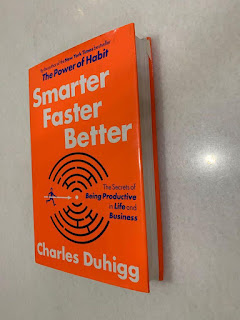
Smarter Faster Better book summary

Image
Chapter 1: Motivation Our internal locus of control gives us motivation (feels good) to be in control (Example of marine training where the cadets are in control of their environment). “Unless we practice self determination and give our self emotional reward for subversive assertions, our capacity for self motivation can fade.” Choices and actions  we make need to connect to a purpose, why we are doing what we are doing (Simon Sinnik book: Start with why, focuses on that). Chapter 2: Teams Psychological safety defines teams (commitment culture). Higher emotional intelligence to care and listen. Starts with leaders. What are they doing and promoting the team. It is often inefficient in the short term but more productive in the long term. Means giving control to others which creates mutual trust and must show that they are genuinely listening. Chapter 3: Focus Anticipate what should happen next, that day, that drive to work. Use probabilistic thinking as it helps envision the future ...

Starting your job the Agile way

Image
Congratulations on the new job. How do you make the most out of it… the Agile way? To do well at the new job requires experimentation and that is where Agile can help you. How can you start with the best possible start? And use the Agile mindset to go about succeeding in the new position. “Individuals and interactions over processes and tools” Focus is always on the people and how to interact and communicate. For those seeking excellence, the journey starts before your first day. Start by researching and preparing questions. For example, you are told that official hours start at 9, it would make sense to show up at 9. Yet, asking your manager “what time am I expected to show up?” or “what time do people start showing up to the office?” can save you a lot of potential trouble. Imagine showing up on official time just to find out that everyone else is already there. It also shows you are doing your due diligence. Your first day doesn’t have to be the first time you go to the office. Go t...

Who resists agile transformations? and who embraces?

Image
  Who resists Agile transformations? In short, everyone!! Employees, managers, and in some cases, clients. Employees resist it for the following reasons: It is uncomfortable for employees when you ask them to deliver value instead of tasks. Tasks are easier "just tell me what to do and I will do it." Contrast that with a manager asking "I have this problem that is not completely understood that I need solved." What if we implement a solution that the manager doesn't like, or even worse, doesn't solve the problem? It comes with accountability. Everyone wants empowerment, but no one wants to be accountable. It is much easier to complain about doing something useless than making a decision of what needs to be done. You are not only accountable for your individual results, but as a team. We are not used to teamwork as a default mode. In schools we study to achieve individual results and that is what matters. Switching that focus is scary and feels like others ha...

Product manager vs Product owner

Image
The question on the differences of the naming has caused a lot of confusion. I will try to simplify as much as possible here. The product owner is a well defined role in scrum, the scrum guides defines that role as follows: The Product Owner is accountable for maximizing the value of the product resulting from the work of the Scrum Team. How this is done may vary widely across organizations, Scrum Teams, and individuals. The Product Owner is also accountable for effective Product Backlog management, which includes: Developing and explicitly communicating the Product Goal; Creating and clearly communicating Product Backlog items; Ordering Product Backlog items; and, Ensuring that the Product Backlog is transparent, visible and understood. The Product Owner may do the above work or may delegate the responsibility to others. Regardless, the Product Owner remains accountable. What about a product manager? I like how Melissa Perri describes that the job role is called a product manager doe...

Convince clients to work in an Agile way together

Image
“How do we get our clients to work in an Agile way with us?” A lot of companies, especially technology companies, ask this question. Understandably so, they understand the value of Agile yet the clients are rarely ready to join. So what do clients want? In short, a sense of control. And to provide a sense of control we traditionally tried to make the time and cost known, and to do that we pushed known scope. But this is a false sense of control. This attempt to make the unpredictable predictable has failed in client engagements. What we are trying to do in Agile is to flip this formula. We deliver value quickly, not just work, and give the client the ability to adjust. We need to keep in mind the value in the Agile Manifesto “Customer collaboration over contract negotiation.” Where we focus our efforts on collaborating more than negotiating. The approach will vary depending on the client and the level of trust built between you and them. Let us break them down using the Law of dif...

Top excuses for avoiding Scrum

Image
Top excuses for avoiding Scrum As an Agile coach I have come across many different teams and heard a lot of complaints about Scrum. Now Agile is not necessarily Scrum, and an empty implementation of Scrum is not Agile either. Why did I need to make this statement? Because many people confuse those concepts and complain about implementations without the mindset. The focus in this article is on what excuses I heard about Scrum. What was common between all the people complaining was they either did not experience it right or did not immerse themselves in it. I am not claiming Scrum is not difficult, it is simple to start yet difficult to master and get right. You might feel you or some members of the team have those excuses and it is fine. hopefully, this article will help you understand how to use Scrum correctly and make the most of it. Our requirements change daily and we need to be Agile and a sprint doesn’t allow us to be adaptable : While a shorter cadence may be appropriate, tha...

Top 5 Agile diseases and their cures

Image
Sometimes we know something is wrong, but we do not what is the problem exactly. I might be able to shed some insight on Agile problems that you might be facing. These are the top 5 Agile diseases: 1 If your Scrum implementation is suffering from: You have long standups ignoring the retrospective as a way to improve the way we work working on “urgent” stories during the sprint. Disease: Framework headache The Agile doctor prescribes : Read up on scrum and the scrum guide and understand what you are not doing correctly. 2 If your Agile implementation has: Large backlogs that rarely change Release cycles are longer than 2 months We need to finish # of stories more than 2 months into the future Disease: Refusal to learn. You do not approach complex problems trying to understand what works best, and it is impossible to build a solution without experimentation. You are also missing out on capturing value by delivering faster. The Agile doctor prescribes : Think shorter cycles of learning, r...

Agile and survival during COVID 19

Image
Humans under sever trauma  have four responses: Fight, flight, freeze or fawn. During COVID we saw all those reactions in the workplace. That is not sustainable as we need to adapt. Many organizations adapted as an impressive speed. Not because they were ready for COVID 19, no one was, but because they had the ability to adapt to any situation. This ability to adapt is Agile and organizational agility. This goes beyond organizations. Countries were not prepared, as governments through policies and regulations, or as citizens. Some countries adapted and raising testing capabilities, social distancing, and masks. Science was the foundation for their actions. For parents who have children in school had to adapt to online schooling. In Jordan we had a national platform (درسك) and private schools had their own platforms. The largest digital adoption in human history accomplished in a short period of time. To adapt or to be irrelevant. It is a matter of speed at which we can take new act...

How did we get here?

Image
M ost employees are not engaged at work ( 59% as the lowest estimate ). Many organizations are failing to adapt to customer needs and market shifts. I always wondered how did we get here? Understanding the current mindset in the workplace is our invention and what brought us here cannot take us forward. The Progress of the industrial revolution The industrial revolution has brought wealth and abundance we have never seen before. Cars replaced horses, average people can afford to have many shoes, and having a refrigerator in most places is a given. All this seemed science fiction 200 years ago. The pace of progress significantly increased during that period compared to previous history. This included technological and institutional inventions such as patent rights and corporations. Yet,  this pace is not enough anymore, neither is the way of thinking that got us this far. The industrial revolution focused on important aspects, such as efficiency, utilization, and unison. This solidi...

How to deal with extreme changing requirements?

Image
 Let us start by identifying an Agile change to “requirements.” In the Agile Manifesto it does say that responding to change is more valued than following a plan. However, that does not mean that Agile is changing for the sake of changing. So what is the source of that change? And what changes do we want? The answer is in the 2nd principle “Welcome changing requirements, even late in development. Agile processes harness change for the customer's competitive advantage.” So the customer’s competitive advantage is what we change for. The competitive advantage does not change on a daily basis. Not even on a weekly basis. Opportunities do arise sometimes, and the opportunity should be significant enough to drop all what we are working on to pursue it. If your requirements are changing on a daily basis, these are not requirements, these are whims. There are three main costs to this rapid switching: Costs of task switching Lack of clarity of what is needed Inability to deliver consistentl...

8 ways to fake your agile transformation

Image
     Agile is gaining a lot of traction due to the results companies get from proper transformations. This was further seen during the covid19 pandemic as agile companies adapted faster. However, this creates a new problem of the quality of Agile transformations. There is increasing demand but quality of supply cannot keep up. Many transformation efforts are falling into chaos instead of agility and that causes hatred for agile as reflex. This bad implementation is what is referred to as fake agile, and I even heard the term organized chaos. An agile transformation has 3 main dimensions. Culture, structures and processes (or practices). Culture has always been elusive, the agile culture is centered around a mindset that has the values stated in the Agile manifesto as a foundation. Then comes structure, structure provides the depth and is more actionable, yet still difficult, compared to culture. Processes are the most actionable and easiest to understand. This fake Agile ...